
BVRio turns coastal clean-up into a verifiable environmental service in Guanabara Bay
Four years in, the Fishing for Litter programme consolidates a model that turns ocean clean-up into a verifiable and financeable environmental service, with over 500 tonnes removed from Guanabara Bay and around 100 fishers have benefited from a model built with the local community at its heart. Since 2021, BVRio has operated the Fishing for Litter programme, offering payment for environmental services to artisanal fishers who collect waste in mangroves, islands and shallow regions, areas where conventional solutions cannot reach. Every collection is digitally monitored via the Kolekt app, which records the location, material type and disposal destination of every kilogram removed, creating an auditable trail that serves both as a management tool and as the foundation for financial instruments.
Despite plastic pollution in coastal environments being one of Brazil’s greatest environmental problems, public policy responses and inclusion of the productive sector as part of the solution remain insufficient. In Guanabara Bay, the challenge is critical: despite being one of Brazil’s smallest river basins, it is among the three that contribute most to ocean plastic pollution. The accumulation of waste damages ecosystems, reduces the income of fishing communities and exposes a persistent market failure: the absence of mechanisms that assign economic value to the removal and adequate disposal of these materials.
Tests and research for operational expansion
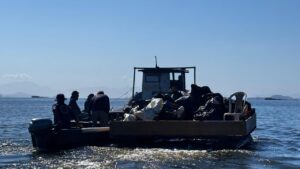
Fishers are testing a barge
With the operation consolidated, the programme is advancing on two fronts. The first is increased collection capacity in critical areas. The fishers themselves built a barge that is now operational in the Bay, enabling the transport of large-volume waste, such as tyres and furniture, and opening the way for trials transporting an adapted mini-excavator for removal in mangrove areas where waste has been accumulating for years beneath the surface. The second involves developing solutions for materials with no conventional recycling viability, in partnership with Federal University of Rio de Janeiro through the NIDES Lab, including routes such as pyrolysis, as well as the prioritisation of collection and interception areas.
From removal to verifiable environmental service
The experience accumulated suggests that waste removal, when combined with traceability and independent verification, can be structured as a payment for environmental services (PES) combined with legal obligations and voluntary commitments from producer companies. The cost benchmark already exists: R$4,000 per tonne, a concrete starting point for discussions on scale and pricing. This model has direct implications for Extended Producer Responsibility (EPR) policies and voluntary environmental credit markets, mechanisms currently developing in Brazil that require precisely the kind of data infrastructure and governance the programme has been building.
A broader arrangement in construction
The recovery of Guanabara Bay requires an arrangement that connects those who finance, execute, research and govern. Alongside the operational progress of Fishing for Litter, BVRio is developing the foundations for a governance structure to solve the pollution of the Bay, bringing together the private sector, civil society, academia and government around shared targets and transparent mechanisms for financing and accountability.
With developed technology, a tested operation based on real data for payment for environmental services, the programme stands today as one of the most advanced initiatives in Brazil at the convergence of coastal waste management, productive inclusion and environmental finance.


