
Circular Economy and Climate: Solutions for Waste Management in Brazil and beyond
Waste management is one of the world’s greatest urban, environmental, and social challenges, and also one of the areas with the greatest potential for progress in climate action in Brazil. To contribute to this progress, BVRio convened an event during Rio Climate Action Week, bringing together the country’s foremost policy makers, thinkers, activists and financiers for a day of discussions and experience sharing, with standing room only for an audience of over 140 people.
Watch the whole event on BVRio’s YouTube Channel
The event, titled “Waste Management and Circular Economy” was held at the CCBB Rio de Janeiro, and brought together 19 speakers with a wide range of perspectives. Representatives from the Ministries of Environment and Development, Industry and Commerce, the Rio de Janeiro State Secretariat for Environment and Sustainability, WWF-Brazil, Firjan, Comlurb, L’Oréal, O Boticário, Wise Plásticos, Cazoolo Lab, Sistema B, Black Forest, Orla Rio, and representatives from waste cooperatives and the International Alliance of Waste Pickers were also present. The diversity of stakeholders gathered reinforced how local and global dialogue must work together to generate impact.
Talks during the day touched on several different themes, which were split over four panel discussions and with questions from the audience.
Policy and the Global Plastic Treaty
Taking place just a few weeks after the latest and inconclusive INC Global Plastic Treaty talks, several speakers were reflective of them and local policy measures during the event.
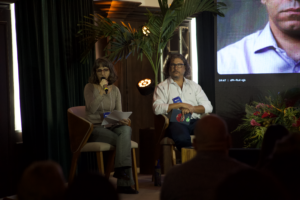 Speaker at the first panel on the international landscape, Carlos Fonseca, from Brazil’s Ministry of Environment and Climate Change, highlighted the urgency of aligning national policy with global negotiations, noting that this international debate helps distinguish more committed governments from those less willing to advance, providing strategic insights for diplomacy: “Brazil is the largest plastic producer in Latin America and the fourth largest generator of plastic waste in the world. Much of it ends up in the ocean, we need to turn off the tap,” said Fonseca, adding that the Ministry is developing a proposal for “a Global Plastic Fund, that would offer non-repayable resources for countries to implement public policies and concessional loans to support industrial transition and strengthen collection and recycling systems.”
Maria Accioly, BVRio circular economy specialist, emphasised that “even though we don’t have a global treaty, the INCs process has already had a positive result, as it has attracted public attention and generated intense discussions about the problems caused by plastic pollution.”
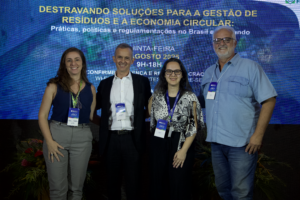
Mauricio de Moura Costa (BVRio) moderated the session ‘National outlook: Regulation and implementation in Brazil’. Speakers included Mona Rotolo (State Secretariat for the Environment and Sustainability – SEAS), Edson Freitas (ANCAPRE – National Association of the Recycling Value Chain), and Carolina Zoccoli (Federation of Industries of the State of Rio de Janeiro – Firjan).
The waste value chain
The event explored how links in the materials/waste value chain can impact each other, encouraging a critical look at current processes and products, enabling them to be rethought and adjusted to facilitate processes across the chain as a whole. “This convergence is essential: only then will we be able to build solutions that make products more circular and sustainable, promoting a positive impact across the entire chain,” said Pedro Succar, a circular economy specialist at BVRio.
On the consumer goods side, Maria Eduarda Figueiredo of L’Oréal highlighted that the group has undertaken a global goal of reducing virgin plastic use by 50% by 2030, but that in Brazil it still faces practical barriers: “The biggest challenge is ensuring traceability and safety of recycled plastics in contact with consumers’ skin.”
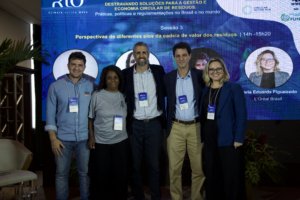
Pedro Succar (BVRio) moderated the session ‘Perspectives from different links in the waste value chain‘. The discussion brought together Marcelo Sicri (Comlurb), Marta Nistaldo (CoopIdeal), Bruno Igel (Wise), and Maria Eduarda Figueiredo (L’Oréal Brazil).
Bruno Igel, of the recycling company Wise Plásticos, highlighted the sector’s limitations: “Plastic is not all the same. Each type requires a specific process. Brazil collects more than 90% of its waste, but the big challenge is to enable, together with waste picker cooperatives, a circular economy on a scale compatible with waste generation.”
Corporate demands also connect with public management. Marcelo Sicri, of Comlurb (Rio de Janeiro’s Municipal Urban Cleaning Company), commented that, “There is a challenge to increase selective collection more than tenfold, fostering the waste picker market, professionalising them, and offering better working conditions.”
At the national and local level, examples from Rio de Janeiro’s experiences demonstrate progress in municipal waste management and reverse logistics initiatives. Representatives from companies and industry federations demonstrated how they have been implementing circularity practices in their operations, highlighting both achievements and regulatory and structural obstacles.
This journey, from producer to consumer, passing through public administration, cooperatives, and recyclers, made it clear that no link advances alone. The convergence of innovation, social inclusion, and consistent policies is the only way to transform local challenges into solutions with global impact.
The vital role of waste pickers
 Statements from waste pickers emphasised the social dimension of this process. Marta Nistaldo, of CoopIdeal, stated that “100% of the cooperative’s members identify as Black, and 70% are women and mothers. Our job is to provide dignity and show that they are workers in the recycling chain with an essential role in sustainability.”
She also highlighted the broader urban challenge: “Recycling cooperatives play a crucial socio-environmental role in cities. In Rio de Janeiro alone, 10,000 tonnes of waste are sent every day to the Seropédica landfill, the equivalent of 1,000 trucks, according to Ciclo (2024). Of this total, around 33.6% is dry recyclables that could be recovered by waste cooperatives instead of being discarded.”
Michel Santos, from WWF, offered reflections on how to expand climate ambition through waste management, with proposals ranging from reducing waste generation to valuing the work of waste pickers.
Solutions
The event also provided a showcase of solutions already in practice, providing concrete evidence of a circular economy being built in Brazil. Participating in this showcase were Orla Rio, Black Forest/Reverse Lab, Cazoolo (Braskem), O Boticário Lab, and various BVRio initiatives, including a cooperative professionalisation project and the Fishing for Litter Programme. The presentations reinforced that innovation is already underway but requires scale and consistent public policies to consolidate. It has become clear that the circular waste economy is not just an urban management agenda: it is a central axis in the fight against climate change.
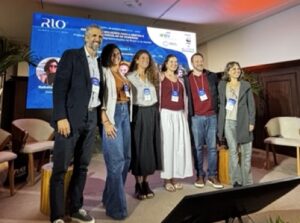 The session ‘Showcase of circular economy solutions‘ featured presentations by Nathália Barreto (Orla Rio), Rafaela Craiser (Black Forest / Reverse), Fabio Sant’Ana (Cazoolo – Braskem), Ísis Westphal (O Boticário), and Pedro Succar (BVRio).


