
Sustainable finance and low-carbon agriculture: pathways to COP30
Agriculture and land use are Brazil’s largest sources of greenhouse gas emissions, but also hold the greatest potential to deliver solutions. As a strategic pillar of the national economy and a decisive front in the climate agenda, the sector has become a top priority for climate finance. This urgency set the stage for the event ‘Financing Agricultural and Climate Transition’, organised on 27 August by BVRio and Sustainable Investment Management (SIM) as part of Rio Climate Action Week (RCAW).
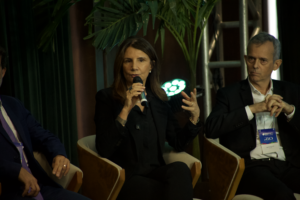 “There is no longer a climate and environment debate without finance”, highlighted Ana Toni, CEO of COP30, during the event, underscoring the weight of the discussions for Brazil’s economic and climate agenda. With a packed audience of more than 110 people, the event gathered government representatives, multilateral banks, the private sector, academia, farmers and civil society across four dynamic panels with 28 speakers. Discussions explored practical ways to scale up low-carbon agriculture, accelerate environmental compliance and mobilise capital for conservation and restoration, placing Brazil at the forefront of global climate negotiations in the run-up to COP30 in Belém.
Among the participants were the Ministry of Environment and Climate Change (MMA), Ministry of Finance, Banco do Brasil, BNDES, the Amazon Fund, World Bank, Santander and Itaú Unibanco, alongside organisations such as IICA Brazil, Amigos da Terra – Amazônia Brasileira, WWF-Brasil, Proforest and Agroicone.
Watch the full event on BVRio’s YouTube channel
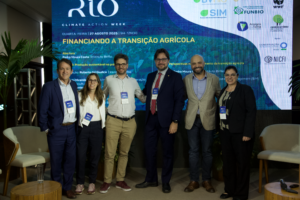
Pedro Moura Costa (BVRio) moderated the panel ‘Financing the agricultural transition’. The session brought together Mauricio de Moura Costa (Sustainable Investment Management – SIM), Leila Harfuch (Agroícone), José Pugas (Regia Capital), Martha de Sá (Violet Vert), Maxime Garde (WWF), and Raoni Rajão (Federal University of Minas Gerais – UFMG).
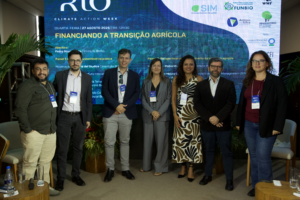 Roberta del Giudice (BVRio) moderated the panel ‘Sustainable production in practice’. The discussion featured Renata Miranda (Inter-American Institute for Cooperation on Agriculture – IICA), Pedro Burnier (Amigos da Terra – Brazilian Amazon), Cecília Gonçalves (Proforest Brazil), Pablo Majer (WWF-Brazil), Charton Locks (Produzindo Certo), and Gabriel Lui (Brazilian Forest Service – SFB).
Speakers emphasised that public and private mechanisms must work hand in hand. Recent advances such as Brazil’s green taxonomy, the regulated carbon market, the EcoInvest programme and a strengthened Fundo Clima are moving in parallel with market instruments including green bonds, Environmental Reserve Quotas (CRAs), impact funds and blended finance structures. The challenge now is scaling with integrity, ensuring robust metrics, strong governance and verifiable results on the ground.
Gabriel Lui, from the Brazilian Forest Service, announced that the government is preparing to issue the first Environmental Reserve Quotas (CRAs) later in October, highlighting the CRA as an effective compensation instrument to achieve land regularisation while encouraging conservation and environmental restoration. Since the enactment of the Forest Code, BVRio has developed all the necessary infrastructure to establish the Forest Reserve Credits market and support rural landowners in meeting their Legal Reserve obligations.
Pedro Moura Costa, BVRio co-founder, remarked, “We created BVRio to design financial mechanisms that could unlock the implementation of environmental law. Today, the world recognises that without finance there can be no climate transition.” Ana Toni echoed, “There is no longer a climate and environment debate without finance. The challenge is to turn commitments into predictable financial flows and to channel more resources to underfunded areas, such as adaptation and nature-based solutions.”
André Aquino, Secretary for Green Economy at MMA, noted that land use, forests and agriculture are “Simultaneously central to climate mitigation and adaptation, biodiversity and water security, yet remain underfinanced.” Stressing here the need to align instruments such as Brazil’s Plano Safra with environmental outcomes and incentives for those maintaining native vegetation beyond the legal minimum.
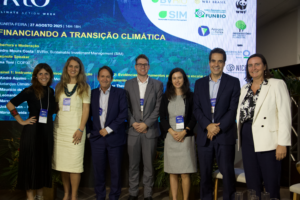 Simone Bauch (Ministry of Environment and Climate Change – MMA) moderated the panel “Evidence and public instruments to scale up climate finance.” The session brought together Vilmar Thewes (Banco do Brasil), Cláudia Tufani (World Bank), Leonardo Pereira (BNDES BIP), Fernanda Garavini (Amazon Fund), and Ana Carolina Szklo (VCMI / Global Coalition to Grow Carbon Markets).
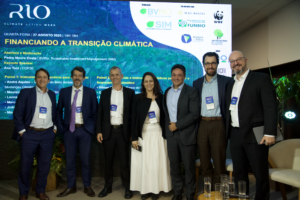 Pedro Moura Costa (BVRio) moderated the panel “Financial instruments for the transition.” The discussion featured André Aquino (Ministry of Environment and Climate Change – MMA), Mauricio Moura Costa (Sustainable Investment Management – SIM / Responsible Commodities Facility – RCF), Leonardo Fleck (Santander), Marcela Paranhos (SAIL Investments), João Adrien (Itaú BBA), and Mário Almeida (Ministry of Finance / EcoInvest).
Within this context, the role of the Responsible Commodities Facility (RCF), an initiative by SIM, was emphasised as a way to promote the production and trading of responsible soy in Brazil by creating a financially sustainable vehicle to provide incentives to farmers who conserve native vegetation and meet social and environmental criteria, helping with the growing international demand for zero-deforestation supply chains. Having recently completed its fourth investment round, Maurício de Moura Costa, co-founder of BVRio and Director of SIM, shared their experience, “Blended finance works in design, but implementation is complex; it must reconcile banks, impact investors, corporates and multilateral capital.”
Mário Almeida, from the Ministry of Finance, presented the new EcoInvest credit line, highlighting its potential to drive and expand initiatives such as the RCF. “We see EcoInvest as a transformative initiative to promote sustainable agriculture in Brazil,” said Pedro Moura Costa, co-founder of BVRio. The view was shared by representatives from Santander and Itaú banks, who also emphasised the innovative nature of the proposal.
With COP30 approaching, participants underlined that Brazil has the opportunity to demonstrate, through solid financial instruments and strengthened environmental governance, that it is possible to reconcile production, conservation and development.


