
The new Brazilian Forest Code: Call for a truce and for a focus on implementation
Author: Pedro Moura Costa
In 2012 the new Brazilian Forest Code (Forest Law 12.651) was adopted after a long and exhausting political process. Like most existing laws in Brazil, the Forest Code is not perfect. Consequently, a series of demands for changes and alterations have been raised by, on one side, rural landowners and agribusiness, and on the other the environmentalist sector. Each sector has pursued actions to change the requirements to better reflect their aspirations. These include various claims of unconstitutionality (Ações Diretas de Inconstitucionalidade – ADIs) raised by the environmental sector, as well as draft law bills, decrees and legal opinions backed by different segments of the agribusiness sector.
Over all of this time, BVRio has been actively working on several fronts to support the implementation of the new Brazilian Forest Code. Based on this experience, we conclude that, regardless of their merits, such demands have resulted in significant delays in implementation of the Code, with resulting negative impacts on the environment and the productive sector.
The following table summarizes the main alterations of the Forest Code proposed by the different stakeholder groups: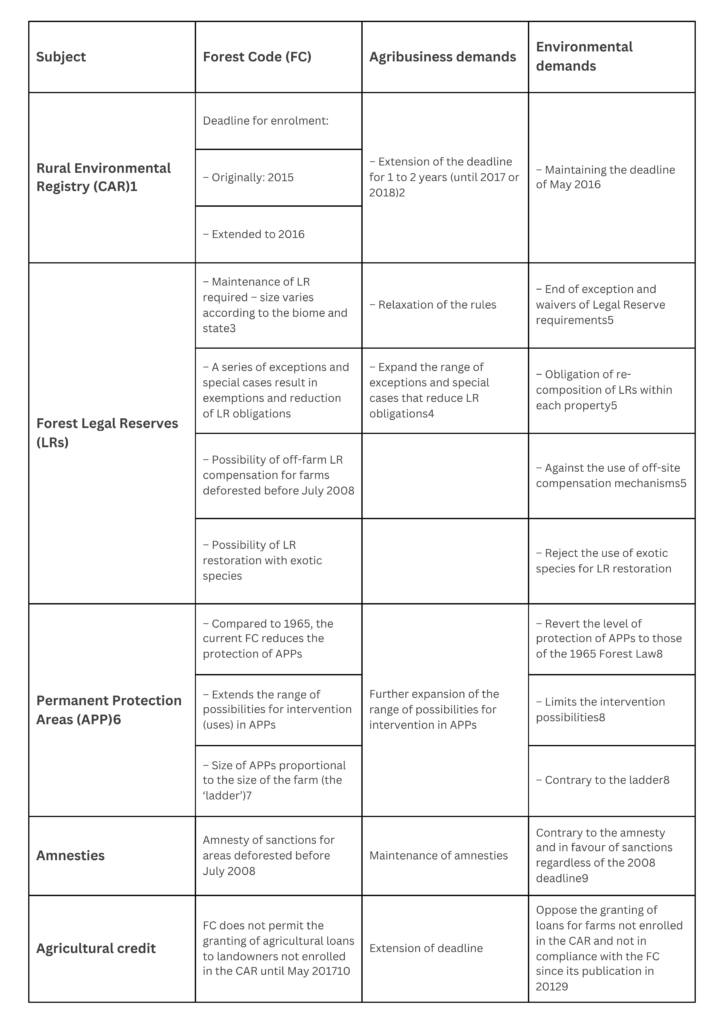
- The Forest Code establishes that every rural property in the country has to be enrolled in the Rural Environmental Registry (CAR), a georeferenced digital registry connected to satellite images that enables monitoring and mapping of land use in rural properties. The original deadline was May 2015, already extended to May 2016.
- Bills 4550/2016 and 4598/2016 from Congress and Senate Bill 287/2015 propose extending the deadline for enrolment with the CAR by 1 to 2 years (to 2017 or 2018).
- The Forest Code requires that all rural properties in the country maintain a certain amount of land under native vegetation (called “Legal Reserves”). The size of Legal Reserves can vary from 20% to 80% of the property, according to the type of vegetation (biome) and the region in which the properties are located. Specifically, properties with forest cover located in the Amazon region need to hold 80% of legal reserve while properties in other biomes (Atlantic Forest, Cerrado, Pampa, Caatinga and Pantanal) need to keep only 20% of native vegetation. An exception is the case of properties containing Cerrado vegetation located in the Amazon region, which need to maintain 35% legal reserve.
- Several bills (e.g., Law nº 18.295, 10 November 2014, Estado do Paraná; Law nº 15.684, 14 January 2015, Estado de São Paulo), legal opinions (e.g.,http://www.agrolink.com.br/noticias/NoticiaDetalhe.aspx?codNoticia=108912), and publications (e.g., http://www.agroicone.com.br/$res/arquivos/pdf/140305144023_codigo-florestal-brasileiro-e-um-dos-temas-de-discuss%C3%A3o-da-65-reuniao-anual-da-SBPC-2607.pdf, http://dinheirorural.com.br/noticia/artigo/areas-consolidadas-permitem-regularizacao-ambiental-diferenciada; http://www.evaristodemiranda.com.br/postagens/acabou-a-exigencia-de-reserva-legal/) seek to legalize past deforestation based on the dates of previous legislation. In the Legal Amazon, the discussion focuses on laws from 1996 and 2000, and outside the Amazon on laws from 1934, 1965, 1989 and 1991.
- Unconstitutionality claims (Ações Diretas de Inconstitucionalidade) 4901 and 4937, under consideration by the Supreme Court (STF) since 2012.
- The Forest Code establishes the obligation for maintenance of native vegetation in sensitive areas, such as– riverine zones, hilltops, etc., the so-called ‘Permanent Protection Areas’ (APPs). The extent of such areas has been the subject of much negotiation.
- The negotiations related to APPs resulted in a complex step-wise system for determining the size of APPs, dependent on the size of the farm (‘the ladder’ or ‘escadinha’). Most environmentalist groups rejected the adoption of this system.
- Unconstitutionality claim (Ação Direta de Inconstitucionalidade) 4903, under consideration by the Supreme Court (STF) since 2012.
- Unconstitutionality claim (Ação Direta de Inconstitucionalidade) 4902, under consideration by the Supreme Court (STF) since 2012.
- The original requirement was that farmers that do not comply with the Forest Code as a whole would not be allowed to receive agricultural loans from government banks. The final text of the Law confined this conditionality to enrolment with the CAR system only.
A truce in the disputes and a focus on implementation
Full implementation of the law as it stands would result in a significant improvement of governance related to land use and a substantial contribution to biodiversity conservation and carbon storage at a landscape scale, placing the Brazilian agricultural sector at the forefront of global sustainability. If fully implemented, the Forest Code has the potential to protect more than 150 million hectares of native vegetation in Brazil, storing about 100 Gt CO2 and making a significant contribution to biodiversity protection.
Undoubtedly, the Forest Code contains imperfections, contradictions and inconsistencies, and does not fully represent the aspirations of any stakeholder group. However, the 2012 Law should be seen as the “only deal possible at the moment.” Any process of alteration to its contents could result in tortuous re-negotiations and, at the same time, create precedents for further demands for change. And, in the meantime, the resulting uncertainty serves as an excuse for non-compliance and no enforcement on the ground, as well as for postponing the process of regulation of the law at the state and federal levels.
In the current scenario, the Forest Code still remains mostly on paper. A concerted effort has to be made to ensure its implementation in the field. Demands by both sides for amendments of the law, either to restrict or expand its environmental protection obligations, have resulted in negative impacts on the environment, delays in its implementation, and a very damaging continuation of legal uncertainty surrounding land use and agricultural production. A truce is needed in these demands, so that the first phase of implementation of the Code can get underway, with all the associated improvements in land management for the country. In the future, once implementation is well under way, revisions can be conducted aimed at improvements of the law, but today this debate is prolonging a process that is detrimental to both the productive sector and the environment.


