Archive - Author: Lucy Cox

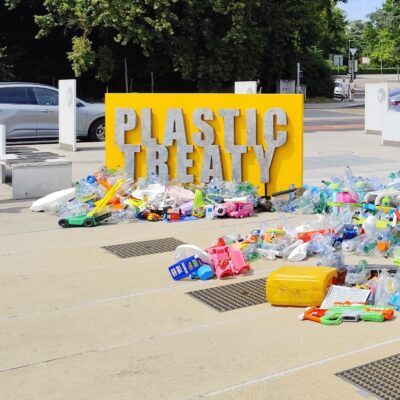
Reflections on INC 5.2 Talks: A Step Forward in Global Plastics Regulation

Since 2022, BVRio has been following the negotiation process inside the UN to develop an international legally binding instrument on plastic pollution, including in the marine environment – a Global Plastic Treaty.  In August in Geneva we participated in the INC 5.2 (the second part of the fifth meeting of the Intergovernmental Negotiating Committee), which […]

Read more...

RCF concludes fourth round of investment to expand funding for zero deforestation soy cultivation in the Brazilian Cerrado

Now in its fourth season, the Responsible Commodities Facility (RCF) fund will provide US$60 million in loans to soy farmers in the Brazilian Cerrado, raised through its innovative blended environmental finance structure.  The Green CRAs issued to capitalise the RCF obtained a Second Party Opinion (SPO) from environmental advisory firm ERM-NINT, which concluded that the […]

Read more...

Financing the Climate and Agricultural Transition

Wednesday, 27 August 2025 | 09:00–18:00 | CCBB Rio de Janeiro | 4th Floor – Multiuse Room With extensive expertise in environmental finance and sustainable land use, BVRio is hosting this session to discuss financial strategies and field experiences that support a just agricultural transition, as well as financial instruments that can drive the shift […]

Read more...

Unlocking Solutions for Waste Management and the Circular Economy: A deep dive into current practices, waste policy & regulations

Thursday, 28 August 2025 | 09:00–18:00 | CCBB Rio de Janeiro | 4th Floor – Multiuse Room With extensive experience in waste management and inclusive circular economy models, BVRio is convening this multi-stakeholder event to explore Brazil’s regulatory framework and showcase practical solutions across the waste value chain. Panels: International waste policy and the global […]

Read more...

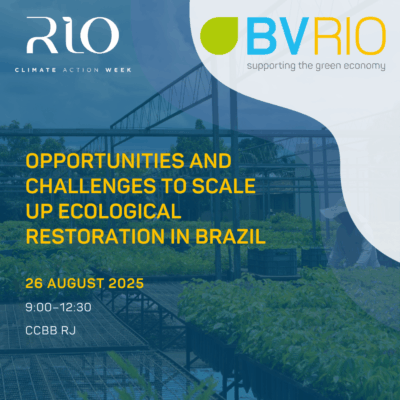
Opportunities and Challenges to Scale Up Ecological Restoration in Brazil

Tuesday, 26 August 2025 | 09:00–12:30 | CCBB Rio de Janeiro | 4th Floor – Multiuse Room Drawing on its expertise in this field, BVRio, in partnership with other organisations, will host this event to promote dialogue on the strategies, partnerships and financial mechanisms needed to scale up ecological restoration efforts in Brazil. Panel 1: […]

Read more...

EPR Focus: Who pays?

By Thierry Sanders, Founder, of Kolekt Extended Producer Responsibility (EPR) is gaining traction globally as a vital policy tool to tackle the growing challenge of waste management. The principle is simple yet powerful: the companies that introduce products and packaging into the market should bear the financial and/or physical responsibility for their post-consumer fate. For […]

Read more...

EPR Focus: In verifying EPR, declaring products, not just material Kgs is essential

By Thierry Sanders, Founder of KOLEKT A seemingly technical detail in Extended Producer Responsibility (EPR) regulation holds the key to its success or failure: how producers declare the packaging they put on the market. Two approaches are vying for policymakers’ attention: The first, simpler at first glance, asks companies to report the total weight (in […]

Read more...

EPR Focus: VAT and EPR Regulations: A recipe for waste picker exclusion

By Kolekt Director, Thierry Sanders. Extended Producer Responsibility (EPR) schemes, designed to make manufacturers shoulder the burden of managing their products’ post-consumer fate, are increasingly seen as a vital tool in the fight against the global waste crisis. Yet, in many emerging economies, an unlikely antagonist is undermining their effectiveness: Value Added Tax (VAT). This seemingly innocuous […]

Read more...

EPR Focus: Should EPR be a top-down affair, orchestrated by government decree, or a bottom-up initiative driven by industry itself?

Whose Rubbish Is It Anyway? The Battle for Control of Extended Producer Responsibility Regulations. By Kolekt Director, Thierry Sanders. The bins overflow, the landfills bulge, and the tide of discarded packaging, electronics, and textiles continues to rise. In response, Extended Producer Responsibility (EPR) – a system holding producers accountable for the post-consumer fate of their […]

Read more...