Category: Opinion

Campanha de solidariedade aos catadores e catadoras do Brasil

Cologne & Waste Pickers: The evolution of waste collection

Circular Action Director, Thierry Sanders, reflects on this year’s Plastic Waste Free World Conference & Expo and on the evolution of waste collection. The hall of the Plastic Free World trade fair at the Kolner Messe is bustling with international visitors passing by stands of paper packaging as alternatives to plastic. Also on display are […]

Read more...

Corresponding Adjustments and their Impact on NDCs and Additionality

Published on Ecosystems Marketplace, this opinion piece by BVRio Director, Pedro Moura Costa, aims to illustrate the impacts of corresponding adjustments on voluntary carbon markets, a useful analysis to inform policymakers and market players as to when to require the use of adjustments. Enthusiasm for international carbon trading must be tempered by the need to […]

Read more...

The EU proposal to reduce deforestation, what does it mean for the timber sector?

The European Commission has proposed a new regulation to reduce global deforestation and forest degradation driven by EU consumption of certain commodities. If enacted, the proposed regulation would repeal the EU Timber Regulation (EUTR), therefore, having relevant implications for this sector. In this article, BVRio outlines some of the features of this proposal. The proposed […]

Read more...
Tetekon is the new Iroko : Lesser-Known Timber Species are the best way to go!

Tetekon is the new Iroko : Lesser-Known Timber Species are the best way to go!

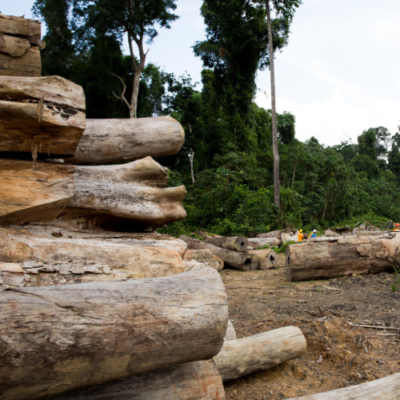
There are over 50,000 species of timber in the world, but only a small fraction is widely used commercially. This, however, does not mean that the rest of the species are unsuitable for a variety of commercial uses. There under-utilised species are known as Lesser-Known and Lesser-Used Timber Species (LKTS) and can often substitute more popular species in terms of performance and aesthetics, and cost-effectiveness. This makes choosing LKTS a good business decision, which also has the potential to improve livelihoods and protect biodiversity.

Read more...
Illegal timber trade from Brazil and the need for robust due diligence

Illegal timber trade from Brazil and the need for robust due diligence

At the 12th BRICS Summit, held via video conference on the 17th November 2020, the Brazilian government “threatened to disclose” that “Europeans have purchased illegal timber from Brazil during 2017”.
Indeed, this is true.
Recent analysis by BVRio concluded that a high percentage of Brazilian hardwoods, exported to EU member states and the USA in 2016-2017, had a very high risk of illegality. The study was based on BVRio’s Timber Due Diligence systems, that uses big data analysis and satellite imagery and is able to able to identify the risk of irregularities in 99% of cases.

Read more...
Indonesian forestry sector

Analysis: Indonesian forestry sector

According to the FAO (2015), Indonesia has around 91 million hectares of forested land, which constitutes to 53% of the total land area. Indonesia has three categories of forest land: Conservation Forests, Protection Forests, and Production Forests. More than half of the Indonesian forest area is production forest and 87% is owned by the State.

Read more...

Need for legality in the Brazilian timber sector

Author/s: Pedro Moura Costa & Mauricio Moura Costa   The Brazilian timber sector is responsible for the extraction of more than 13 million m3 of hardwood logs from Amazonian rainforests. These logs, in turn, feed a wood processing industry that around R$ 8 billion in annual revenue. However, the importance of the timber sector has […]

Read more...

The urgent need for implementation of the Forest Reserve Compensation Mechanisms of the Brazilian Forest Code

Author/s: Pedro Moura Costa & Mauricio Moura Costa   Given their importance for facilitating compliance and implementation of the new Brazilian Forest Code, there is an urgent need to create the necessary conditions for using the Forest Legal Reserve Compensation Mechanisms of the Code. In particular, it is essential that these mechanisms be regulated by […]

Read more...
Tropical Forest

The new Brazilian Forest Code: Call for a truce and for a focus on implementation

Author: Pedro Moura Costa In 2012 the new Brazilian Forest Code (Forest Law 12.651) was adopted after a long and exhausting political process. Like most existing laws in Brazil, the Forest Code is not perfect. Consequently, a series of demands for changes and alterations have been raised by, on one side, rural landowners and agribusiness, […]

Read more...