
Restoration and the Forest Code: levers for Brazil’s climate goals
Forest restoration and the effective implementation of Brazil’s Forest Code are among the country’s greatest opportunities to meet its climate targets, while also generating development. This was the guiding theme of discussions on 26 August during Rio Climate Action Week, in events organised by BVRio in partnership with the Forest Code Observatory, Amigos da Terra – Amazônia Brasileira and a range of supporting organisations.
Watch the full event on BVRio’s YouTube channel
In the morning, the session Opportunities and Challenges to Scale Restoration brought together BNDES, Funbio, WRI Brasil, Conservation International (CI-Brasil), FBDS, IBAM, re.green and EcoSecurities. There was broad agreement that large-scale restoration could store billions of tonnes of CO₂ over the coming decades, while also boosting local economies, as it is labour-intensive and capable of generating income in vulnerable regions.
“The challenge is moving from thousands, to millions, of hectares restored. For this, we need stronger institutions, legal certainty and consistent public policies, but much of the finance will come from the private sector. An initiative coordinated by BVRio in partnership with FBDS, FGV and CSF – PlanaFlor makes it clear: implementing the Forest Code does not hold back development; on the contrary, it is expected to boost GDP and reduce the economic costs of deforestation.” said Maurício de Moura Costa, BVRio Director and co-founder.
 In the panel ‘Integrating policies and resources to scale up restoration in Brazil’, participants included Marcos Cardoso Santiago (BNDES), Rosa Lemos (Funbio), Rafael Loyola (FBDS), Alberto Lopes (IBAM) and Viviane Figueiredo (Conservation International Brazil), moderated by Roberta del Giudice (BVRio).
 The following panel, ‘Unlocking the restoration market: innovation and scale in the private sector’, featured Mauricio de Moura Costa (BVRio / PlanaFlor), Thiago Picolo (Re.Green), Carolle Alarcon (Brazil Climate, Forests and Agriculture Coalition), Alessandra Caiafa (Sobre) and Ana Garrido (Ecosecurities), moderated by Ana Cecília Gonçalves (WRI Brazil).
This perspective was complemented by reflections on governance and the experience of the Floresta Viva project, an initiative of BNDES, implemented by Funbio. Rosa Lemos emphasised the central role of governance in scaling up forest restoration. She noted that effective governance is key to ensuring transparency, fostering stakeholder engagement, enabling monitoring of restored areas, and guiding the prioritisation of political actions.
Viviane Figueiredo of CI-Brasil highlighted the importance of strengthening local organisations technically and financially, while Alberto Lopes of IBAM described a project; “Transforming the arc of deforestation into an arc of restoration, with reach across 70 municipalities.”
Speakers agreed that protecting and restoring forests also requires re-thinking Brazil’s territorial organisation, spreading technology and training, transforming landscapes and livelihoods, preventing disasters, ensuring water supply and creating stability for productive sectors.
The role of implementing the Forest Code
In the afternoon, the session ‘Climate and Forest Code Dialogues’ gathered the Forest Code Observatory, Amigos da Terra – Amazônia Brasileira, CI-Brasil, the Ministry of Environment, the Brazilian Forest Service, state environmental secretariats from Pará, Minas Gerais and Acre, CPI, IPAM, WWF-Brasil and the Brazil Climate Coalition.

The panel ‘The Forest Code and Brazil’s climate targets‘ was moderated by Marcelo Elvira (Forest Code Observatory – OCF), featuring Beto Mesquita (Conservation International – CI), Roberta del Giudice (BVRio), and Ana Carolina Crisostomo (WWF-Brazil).
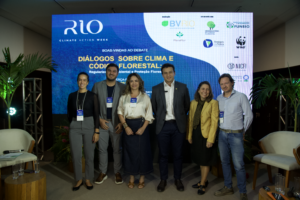
Jarlene Gomes (IPAM) moderated the panel on ‘Environmental regularisation: federal and state perspectives‘. The discussion brought together Henrique Dolabella (MGI), Marcus Vinícius Alves (SFB), Joana Chiavari (CPI), Raul Protázio (SEMAS-PA), Marina Fernandes Dias (IEF-MG), Leonardo das Neves Carvalho (SEMA-AC), and Raul do Valle.
The discussions examined the role of the Forest Code in Brazil’s climate commitments, assessing both challenges and opportunities for advancing the environmental regularisation of rural properties, in light of the current political context and federal actions. Building on implementation data, particularly from environmental compliance programmes, participants also presented solutions and good practices that states are adopting to make progress on the ground.
“The effective implementation of the Forest Code happens locally, at the level of rural properties, when native vegetation is protected, recovered and restored.” said Marcelo Elvira, Executive Secretary of the Forest Code Observatory.
Presenting the results of studies conducted under the PlanaFlor initiative, Roberta del Giudice, Director of Forests and Public Policy at BVRio, emphasized that conservation and restoration are strategic actions to align socioeconomic development with climate goals, with the potential to generate R$ 6.2 trillion in ecosystem services. ‘We are talking about well-being, water security, biodiversity protection, climate resilience, and tangible economic opportunities that should guide policies, investments, and practices in the field,’ said Roberta.
Beto Mesquita, Director of Sustainable Landscapes at CI-Brasil, underlined the scale of Brazil’s natural assets; “The Forest Code is one of Brazil’s most powerful climate tools. Meeting the liabilities of Permanent Protection Areas (APPs) and Legal Reserves alone could represent up to 6.6 billion tonnes of CO₂ stored in the coming decades. If we also preserve the 60 million hectares of surplus Legal Reserves, that figure rises to 21 billion tonnes. And beyond mitigation, this is also about adaptation; more forests mean less flood risk, greater water security and stronger economic resilience.”
The day closed with a clear message: Brazil is uniquely positioned to transform large-scale restoration and the implementation of the Forest Code into engines of the global climate agenda. As well as reducing emissions and preventing deforestation, these actions can generate jobs, income and stability for local communities, providing a strategic pathway for the country to arrive at COP30 in Belém with concrete and large-scale proposals.


