
BVRio and INEA sign new Technical Cooperation Agreement to install the first river barrier managed by the Fishing for Litter programme in Guanabara Bay
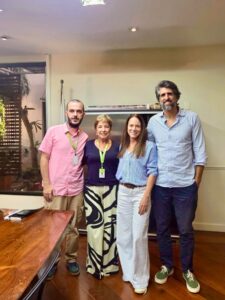 Guanabara Bay receives around 80 tonnes of solid waste every day, carried by the rivers and canals that drain into it. To tackle this problem at the source, BVRio and the State Environment Institute (INEA) have signed a new Technical Cooperation Agreement (TCA) focused on the installation of waste capture river barriers. The agreement was reached last week, at a meeting with INEA President Denise Marçal Rambaldi.
The new TCA aims to scale up the efforts of the Fishing for Litter programme, which has been operational for four years. The programme seeks to remove solid waste from Guanabara Bay by combining technology, community management and income generation for the region’s artisanal fishermen. The previous TCA, signed in 2023, laid the groundwork for collaboration on circular economy, forestry and solid waste projects across the State of Rio de Janeiro.
“Our collaboration with the state government, through INEA, is essential for us to operate with the speed and legitimacy that this problem demands. Guanabara Bay cannot wait.” Pedro Succar, circular economy specialist at BVRio.
A pilot unit, an expansion strategy
The initial proposal is to install a single river barrier on a canal chosen jointly with INEA. This pilot unit will serve as an operational test bed to calibrate waste removal processes, logistics with waste-picker cooperatives, maintenance schedules and monitoring protocols. The lessons learned will inform all future expansion decisions.
The scale of the problem makes the urgency clear. INEA data show that the 17 river barriers currently operating on the main rivers and canals feeding Guanabara Bay removed more than 15,600 tonnes of waste between March 2023 and April 2025, averaging 600 tonnes per month. In January and February 2026 alone, the structures removed approximately 2,000 tonnes. These figures reveal both the magnitude of the crisis and the proven effectiveness of the technology.
For the expansion phase, BVRio intends to identify, scientifically and systematically, which rivers and stretches have the greatest potential impact per new unit installed, taking into account waste volumes, operational accessibility, hydrological dynamics and proximity to waste-picker communities.
Technology that creates livelihoods where it matters most
River barriers have potential that goes well beyond waste capture. In the Fishing for Litter programme, the prioritisation of local operators is deliberate. Wherever possible, positions will be filled by residents of the community closest to where the barrier is installed. It is the logic of the local solution: those who know the river, care for the river.
The agreement also aims to develop technical criteria to ensure that every installation is selective and ecologically responsible. This rigour sets BVRio’s approach apart from purely engineering-led solutions. Waste interception must occur without compromising the ecological function of rivers, which requires both appropriate barrier design and continuous post-installation monitoring. The partnership with INEA is central to this, as the state body holds the operational track record, the hydrological data and the technical expertise to guide decisions that go beyond containment engineering.
A founding link in a broader governance framework
The new TCA is both a technical instrument and a political signal. The Fishing for Litter programme is not intended to be a standalone project, and is being implemented as part of a broader environmental governance architecture for Guanabara Bay. We are working towards a framework that brings together state government, municipalities, the private sector, communities and researchers around shared clean-up goals. The contours of this partnership are still being shaped, but the new TCA with INEA formalises its first institutional link.
Fishing for Litter is a BVRio initiative focused on the removal and proper disposal of solid waste in rivers and canals draining into Guanabara Bay, integrating river barrier technology, circular economy principles and income generation for artisanal fishermen. Investors and partners interested in getting involved are welcome to reach out via bvrio.org.


